

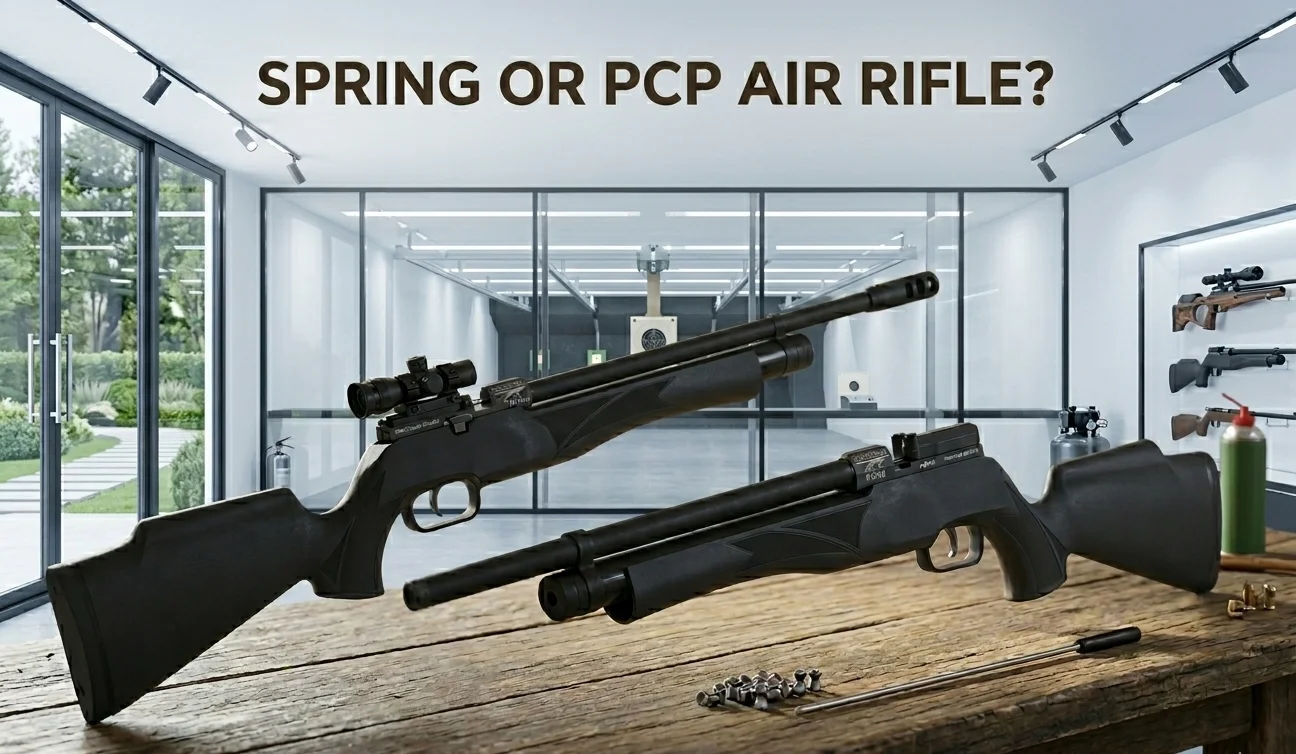
In the subtle theatre of shooting sports, where breath meets stillness and intent sharpens into action, one decision quietly shapes the journey—choosing between spring and PCP air rifles. To the uninitiated, it may appear as a mere technical fork in the road. Yet, for seasoned marksmen, disciplined trainers, and structured academies, this choice echoes far deeper, influencing not just performance, but the very rhythm of learning itself.
Across India, both rifle archetypes stand widely embraced—each carrying its own philosophy, its own temperament. The decision, therefore, is not merely about equipment; it is about alignment—between ambition, infrastructure, and the cadence of skill progression.
Let us unravel this with clarity, yet with the reverence it deserves.
The Mechanical Soul: Understanding Spring Air Rifles
Spring-piston air rifles breathe through mechanics—pure, unembellished engineering. With each cocking motion, a spring is compressed, storing latent energy like a coiled thought. When released, that energy surges forward, propelling the pellet with a decisive thrust.
This design, time-honored and steadfast, has anchored training environments for generations.
Defining Traits of Spring Air Rifles
Spring rifles carry a certain rugged honesty. They offer:
- Self-reliant mechanical consistency, free from external dependencies
- A straightforward, almost ritualistic operation—ideal for repetitive drills
- A modest financial threshold, easing large-scale adoption
- Low-maintenance resilience, enduring frequent use without complaint
Because of these grounded attributes, spring rifles often become the first companions of learners—guiding them through the formative corridors of technique.
The Breath of Precision: Understanding PCP Air Rifles
PCP (Pre-Charged Pneumatic) air rifles, in contrast, operate with a refined elegance. They harness compressed air, stored within a cylinder, releasing it in measured whispers upon trigger pull.
The result? A shooting experience that feels less like force—and more like finesse.
Defining Traits of PCP Air Rifles
PCP rifles are sculpted for those who chase perfection. They deliver:
- Remarkable shot-to-shot uniformity
- Negligible recoil, preserving stillness in motion
- A fluid, almost seamless trigger experience
- Heightened accuracy—where fractions define excellence
These characteristics make PCP rifles the chosen instruments in advanced training grounds and competitive arenas.
Where They Diverge: A Study in Contrast
Understanding the divergence between these two systems is not optional—it is essential.
Accuracy & Consistency
PCP rifles stand as paragons of consistency. Each shot mirrors the last, offering predictability that nurtures precision. Spring rifles, though capable, demand a steadier hand and deeper discipline to match that consistency.
Recoil & Stability
Spring rifles carry a subtle recoil—a gentle reminder of their mechanical heart. PCP rifles, by comparison, are almost meditative, their discharge barely disturbing the shooter’s equilibrium.
Usability in Training
Spring rifles shine in simplicity. No auxiliary systems, no added complexity—just pure engagement. PCP rifles, however, require air charging mechanisms, introducing layers of operational intricacy.
Maintenance & Care
Spring rifles ask little—basic upkeep suffices. PCP systems, on the other hand, require attentive care, disciplined handling, and vigilant monitoring of air systems.
Cost & Infrastructure
Spring rifles are economical, scalable, and easily deployed. PCP rifles demand a larger investment—not just in the rifle itself, but in the ecosystem that sustains it.
Choosing with Intent: Aligning Rifle with Purpose
The decision should never be impulsive—it must be intentional.
For Beginners
Spring rifles are the natural starting point. They instill the essence of shooting—stance, control, timing—without distraction.
For Intermediate Practitioners
A refined spring rifle continues to serve well. At this stage, the shooter refines grouping, consistency, and repetition—building quiet mastery.
For Advanced Athletes
Here, PCP rifles step into relevance. They allow the shooter to transcend basics and pursue surgical precision, where every nuance matters.
In the Ecosystem of Academies
Structured training institutions rarely choose one over the other—they embrace both.
Spring rifles lay the groundwork, shaping raw learners into disciplined shooters. PCP rifles then elevate them, preparing athletes for the unforgiving precision of competition.
This layered progression is not accidental—it is intentional design.
Missteps Along the Way
Even experienced buyers stumble.
- Adopting PCP Too Early: Without foundational discipline, advanced tools can hinder rather than help.
- Ignoring Training Alignment: Equipment must echo the training philosophy—not contradict it.
- Neglecting Maintenance Reality: PCP systems demand commitment; overlooking this invites inconsistency.
The Moment of Transition
Transitioning from spring to PCP should not be driven by desire—it must be earned.
Consider the shift when:
- Shot consistency becomes second nature
- Training intensity escalates
- The pursuit of precision becomes non-negotiable
Only then does the upgrade enhance, rather than complicate.
Final Reflection
Both spring and PCP air rifles are not rivals—they are chapters in the same story.
Spring rifles ground the shooter, instilling discipline through resistance. PCP rifles liberate the shooter, enabling expression through precision.
The true wisdom lies not in choosing one—but in knowing when each belongs.
For those who train, teach, or compete, the most powerful approach is not exclusion—but orchestration. A journey that begins with simplicity and ascends into mastery will always yield the finest marksmen.


